Is 35mm good for street photography?
For me, yes. It may be the best single focal length there is. It is wide enough to hold a person inside their world, close enough to stay intimate, and natural enough that it never distorts the moment. It is the lens that taught me to see the street. That said, the best focal length is always the one you understand deeply enough to use without thinking about it.

Varanasi, India, 2017
Leica M9, 35mm Summicron ASPH f/11 - 1/1000 sec - ISO 500
For my taste, 35mm has a natural beauty. It is close to the human eye, but not exactly the eye. It is a little wider. It breathes. It lets the world enter the frame without becoming too exaggerated. It can hold a person, a gesture, a background, a shadow, and a small accident happening at the edge of the scene. It does not distort life when used with care. It simply gives life enough room to reveal itself.
That is why I keep coming back to it.
Why 35mm feels true
Street photography depends on distance. Too far, and the photograph becomes detached. Too close with the wrong lens, and the scene can become aggressive or distorted. For me, 35mm sits in the right tension. It allows intimacy without spectacle.
Magnum photographer Richard Kalvar explains this beautifully. He says that the 35mm lets him get very close to people, and that although it is not technically a normal lens, it “feels normal” (Magnum Photos). That is exactly the paradox I like. The 35mm is slightly wide, but emotionally it can feel truthful.
Kalvar also says that with a fixed lens “you know where the walls are,” which is one of the most important lessons of working with one focal length for a long time (Magnum Photos). After years with 35mm, the frame becomes physical. You begin to feel where the edges are before raising the camera.
This is not only a technical advantage. It changes the way you move.
The 35mm frame: close enough, wide enough
A 35mm lens is wide enough to include context, but not so wide that the subject disappears into the environment. It is especially useful for the kind of street photography I am drawn to: people inside public life, not people extracted from it.
I want the viewer to feel the place. A person alone is rarely enough. I am interested in the relationship between a person and a wall, a costume and a street corner, a gesture and a patch of light, a shadow and a passing figure. The 35mm gives those relationships space.
It also keeps me physically honest. If I want a stronger picture, I usually have to move closer. I cannot rely on compression. I cannot hide across the street and make the subject come to me. The 35mm asks me to participate in the space.
Kalvar puts it directly: getting closer with a slightly wide-angle lens like the 35mm can intensify and simplify the composition, creating a more intimate image with less unwanted material in the frame (Magnum Photos). That is one reason the focal length has become so central to street photography. It rewards presence.
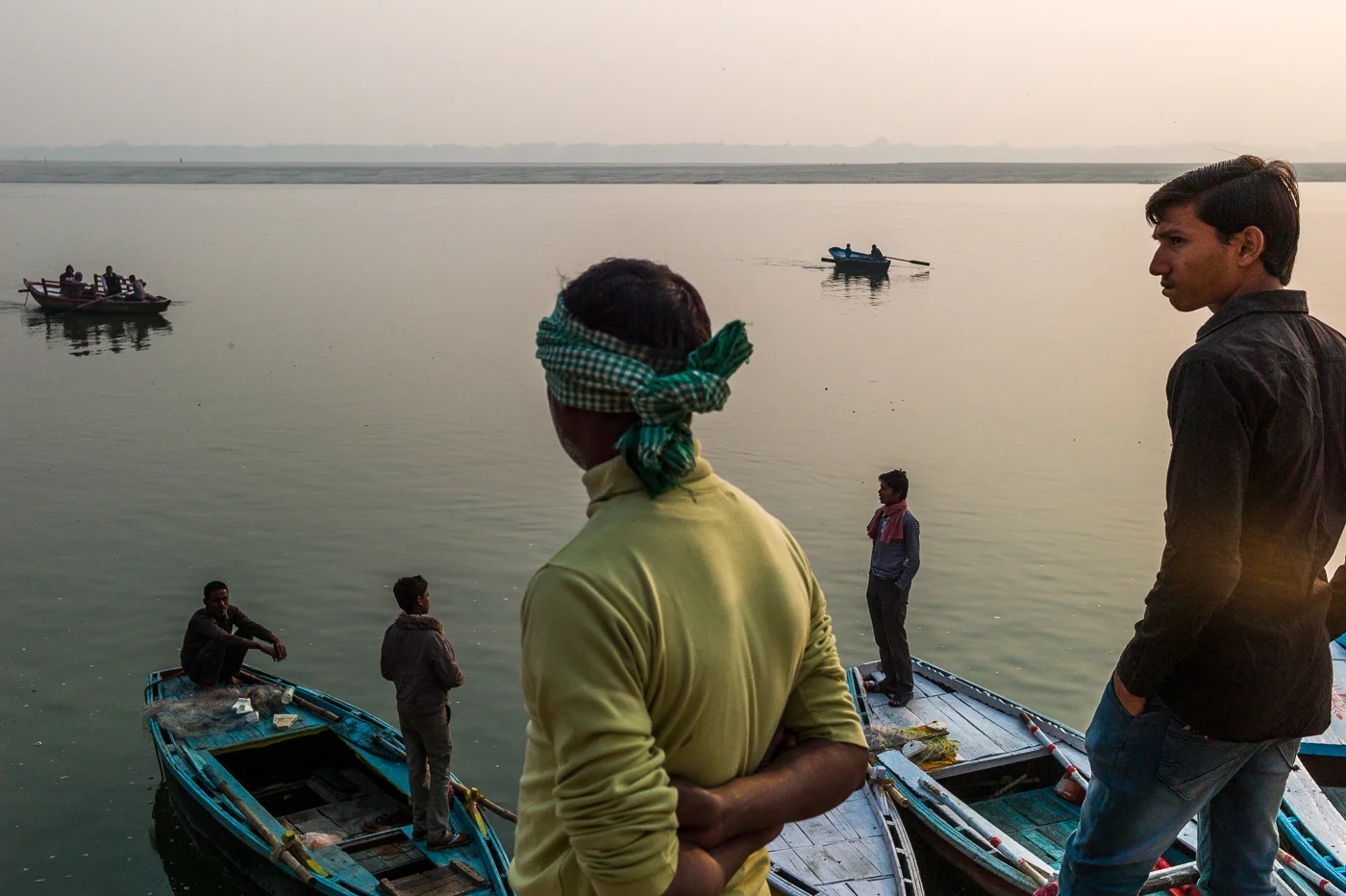
Varanasi, India, 2017
Leica M9, 35mm Summicron ASPH f/8 - 1/1000 sec - ISO 320
35mm on full frame and on crop sensors
One practical note, because it changes everything. When I talk about 35mm, I mean the field of view of a 35mm lens on a full-frame camera. On a crop-sensor (APS-C) body, a 35mm lens behaves more like a 50mm: tighter than the look I describe here. To find this same field of view on APS-C, you want a lens around 23mm. Worth knowing before you choose, because it is the difference between the frame feeling natural and feeling too narrow.
My technical baseline
My basic daylight setup is designed for speed, depth, and readiness. In strong light, I often want enough shutter speed to freeze gesture and enough depth of field to keep layers alive.

These settings are not a formula for every situation. They are a starting point. The goal is to make the camera ready before the street becomes interesting.
With 35mm, I can work quickly, but I can also build a frame slowly. I can wait inside a patch of light. I can follow a market rhythm. I can step forward when two unrelated things suddenly begin to speak to each other.
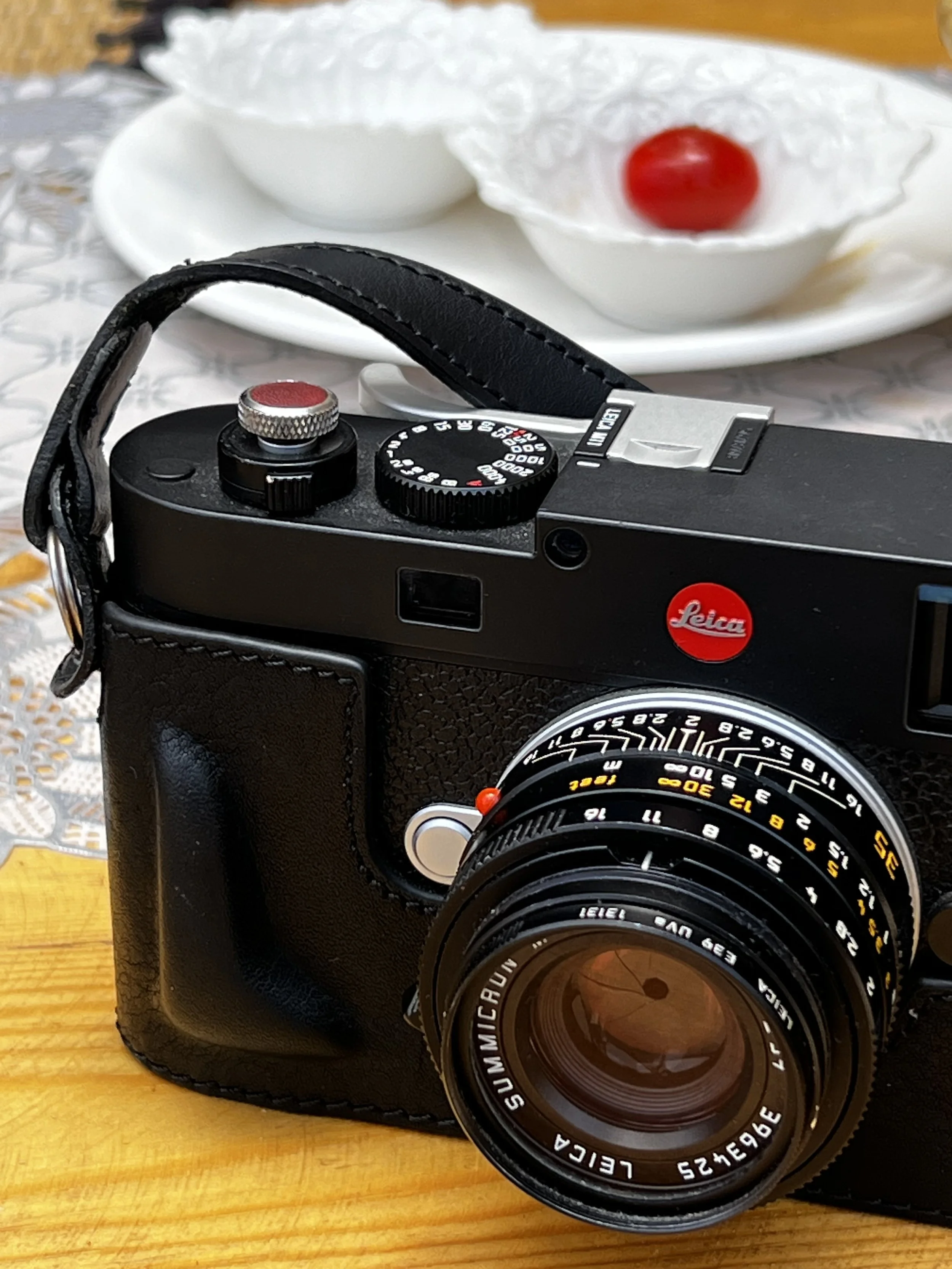
Leica M11 with the 35mm Summicron ASPH
Walking, waiting, reacting
My method is a mix. I walk, I wait, and I react.
Walking lets me discover the light. The sun can transform the street from one minute to the next. A place that looks ordinary at 10:00 can become a stage at 11:30. With 35mm, walking is not just movement; it is a way to let the frame find me.
Waiting is different. Sometimes the background comes first: a red wall, a hard shadow, a doorway, a shop window, a line painted on the street. When the frame is strong, I stay. I let people enter and leave until the scene becomes charged.
Reacting is the third mode. Some pictures happen without warning. A hand rises. A child runs through the frame. A woman in a red dress crosses a red wall. A shadow becomes another figure. The 35mm helps because it is already wide enough to catch the surprise, but not so wide that the photograph loses its center.
Alex Webb’s description of his own process resonates with this. “I work extremely intuitively. I wander, I respond. I don’t work rationally at all,” he says in a Magnum interview about La Calle (Magnum Photos). That sentence is useful because it does not make intuition sound vague. It suggests a discipline of openness.
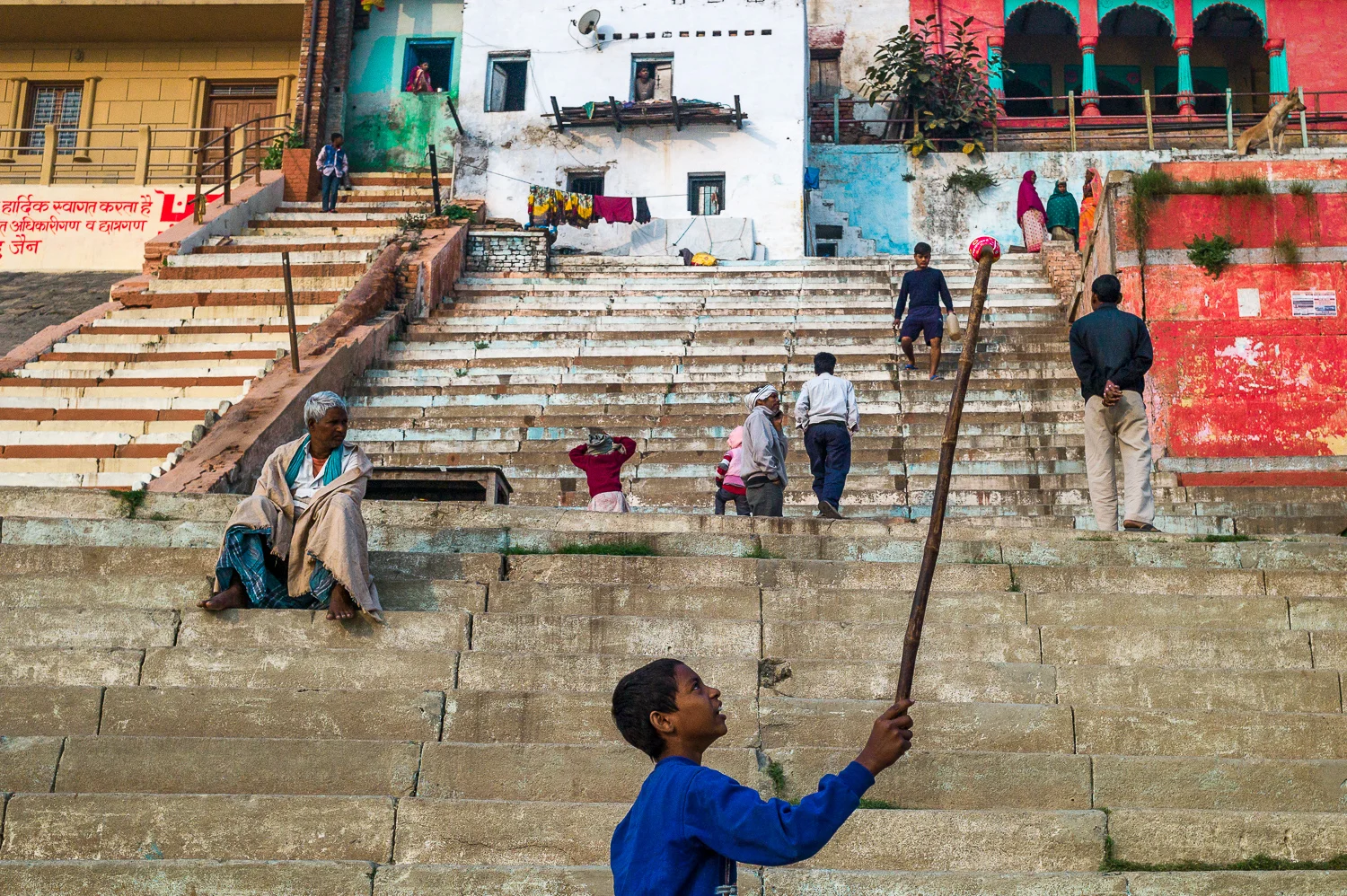
Varanasi, India, 2017
Leica M9, 35mm Summicron ASPH f/8 - 1/1000 sec - ISO 500
Color is structure, not decoration
I photograph in color because color changes the meaning of the street. It is not an extra layer added after composition. It is often the reason to make the photograph.
Alex Webb is one of the photographers who made this clear for me. Magnum describes his work as photographs characterized by intense color and light, with richly layered compositions that distill gesture, color, and cultural tensions into single frames (Magnum Photos). That is a powerful idea for street photography: color is not only beautiful; it can carry tension.
Harry Gruyaert gives another way to think about it. “Color is a way to sculpt what I see,” he says in Magnum’s feature on Homeland (Magnum Photos). I like this because it makes color active. Color shapes the frame. It decides where the eye goes. It can make order out of chaos.
Gruyaert also says, “I’m excited about what I see, it’s about pleasure, it’s about the sheer joy of looking” (Magnum Photos). That matters to me. Street photography can become too clever, too conceptual, too hungry for irony. Sometimes the first reason to photograph is simpler: the pleasure of seeing.

Varanasi, India, 2017
Leica M9, 35mm Summicron ASPH f/2 - 1/60 sec - ISO 2500
Layers: the street as a living rectangle
A 35mm frame is perfect for layers because it can include enough space without losing human scale. I often look for three things at once:
A foreground interruption that makes the viewer enter the image slowly.
A middle-ground human gesture that carries the emotional pulse.
A background detail that changes or complicates the scene.
Kalvar says that, for him, a successful picture is one where everything works together or against each other, but there must be relationships among everything in the picture, even if the connection is only visual (Magnum Photos). That is one of the best definitions of a layered street photograph.
The goal is not to fill the frame with information. The goal is to make the information relate.
Not too clean
I do not want street photographs that are too clean. Clean images can be elegant, but they often lack life. I prefer pictures that have a little resistance.
This is why I like the 35mm field of view. It allows small imperfections to remain inside the frame. A half-seen person. A strange edge. A visual echo that is not completely resolved. A shadow that competes with the subject. These things can make the photograph feel true.
The street is not a studio. It is full of interruptions. The 35mm lets some of those interruptions stay.

Varanasi, India, 2017
Leica M9, 35mm Summicron ASPH f/11 - 1/1000 sec - ISO 640
What I learned from staying with one focal length
Using 35mm for years taught me more than switching lenses ever could. It taught me my distance from people. It taught me when I was too far away. It taught me how much background I need. It taught me to feel the edges.
Working with one focal length builds instinct. The camera becomes less of a machine and more of a measurement inside the body. You know when to take one step forward. You know when the frame is too loose. You know when the edge will cut something important.
This is why I would recommend 35mm not only as a lens, but as a discipline.
How 40mm fits into the story
My recent use of 40mm is not a rejection of 35mm. It is a refinement, or maybe a different mood. The 40mm feels a little calmer, a little more selective, closer to the human eye in a narrower sense. It can be beautiful for quieter scenes.
But 35mm remains the foundation. It is the lens that best matches the way I learned to photograph life in public: close, layered, responsive, slightly wide, and open to accident.
A 35mm vs 50mm note
People often ask how it compares to 50mm. A 50mm isolates; it lifts one subject out of the street and quiets everything around it. A 28mm does the opposite, it pulls in so much you must be almost inside the scene, and the edges begin to stretch. The 35mm sits between them. It keeps the subject and the world in the same breath.
Practical takeaway for serious street photographers
If you want to develop a personal street photography language, choose a focal length and stay with it long enough for it to shape your instincts.
For me, that focal length has been 35mm.
It is wide enough to include life, close enough to feel intimate, natural enough to avoid obvious distortion, and flexible enough to handle color, layers, gesture, shadow, and public theater. It lets me photograph not only people, but the space around people, the life that explains them, and the accidents that make the street feel alive.
My approach is simple:
35mm. Strong light. Color as structure. f/8 to f/11. 1/500 to 1/1000. Zone focus. Walk, wait, react. Let life enter the frame.
Everything starts there.

Varanasi, India, 2017
Leica M9, 35mm Summicron ASPH f/8 - 1/500 sec - ISO 160
FAQ
Is 35mm good for street photography?
Yes. It is wide enough to include context, close enough to stay intimate, and natural enough to avoid distortion, which is why it is one of the most-used focal lengths in the genre.
Why is 35mm popular for street photography?
The 35mm focal length is popular because it is wide enough to include context but not so wide that people become distorted or distant. It works well for layered scenes, environmental portraits, and everyday public life.
Is 35mm close to human vision?
For many photographers, 35mm feels natural because it is close to everyday perception while remaining slightly wider than a strictly normal field of view. That slight width helps include context and movement.
Is 35mm or 50mm better for street photography?
35mm keeps the subject and their surroundings in the same frame; 50mm isolates a single subject more cleanly. For layered, immersive street work, 35mm; for tighter, portrait-like frames, 50mm.
What settings work for 35mm street photography in strong sunlight?
A practical daylight baseline is f/8 to f/11 with a shutter speed around 1/500 to 1/1000, especially when using zone or hyperfocal focusing.
Is 35mm better than 40mm for street photography?
Neither is universally better. A 35mm lens gives more context and energy, while 40mm feels slightly tighter and calmer. For this approach, 35mm is the foundational focal length because it keeps life, space, and accident inside the frame.
How should a serious street photographer use 35mm?
Use it long enough to internalize the frame. Learn your distance, practice zone focusing, move closer when needed, and compose with relationships between foreground, subject, background, color, and light.
Does "35mm" mean the lens or the film?
Both terms exist. A 35mm focal length describes a lens's field of view; 35mm film describes a film format. They share a number but are different things.