What America Looks Like From the Outside
I arrived in Los Angeles in 2018 from Nice, shaped by the Mediterranean, by Algeria, carrying a version of America built entirely from cinema and music. I had never walked an American sidewalk. I thought I knew what I would find.
The streets were not what I expected. Not worse, not better. More complicated than any image I had absorbed over the years.
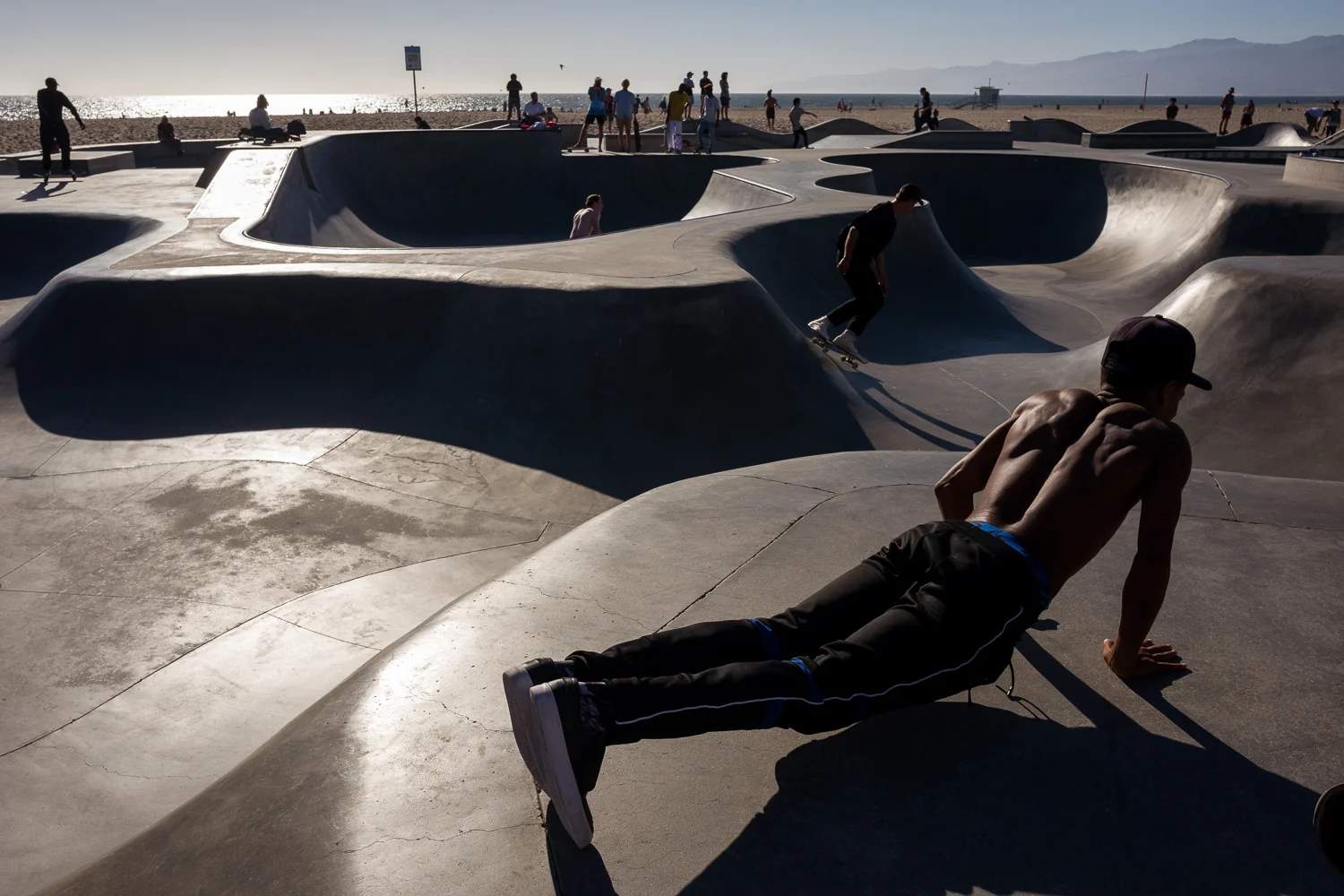
Over two trips between 2018 and 2019, I photographed across four cities: Los Angeles, San Diego, Las Vegas, and New York. The resulting series is called The American Mirage.
Why "Mirage"
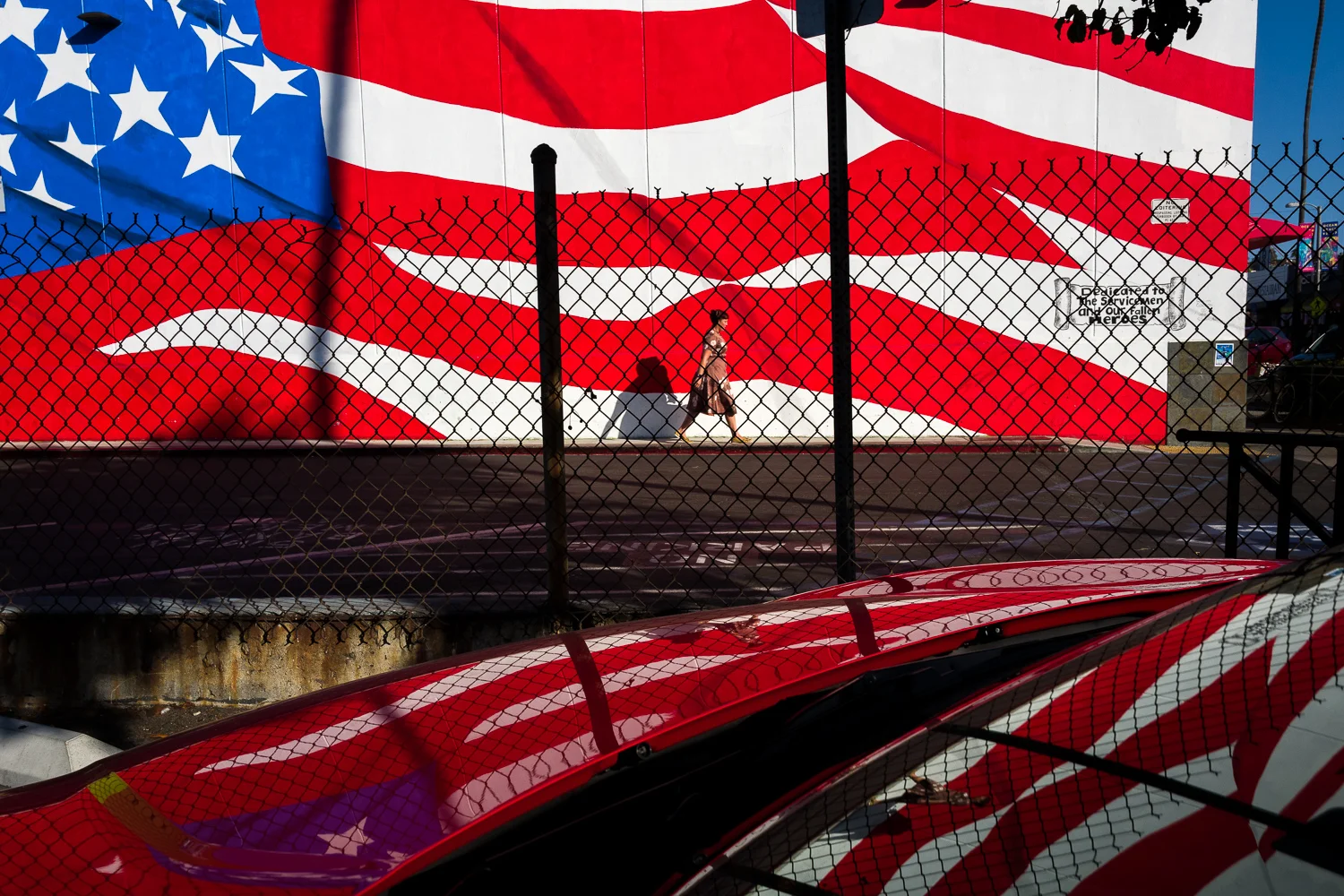
A mirage is not a lie. It is a real optical phenomenon, light bending in such a way that you see something that exists, but not where you think it is.
That is what the American dream looked like from the outside. Something real, but displaced. A country that has been performing its own dream for so long, with such intensity, that the performance has started to separate from whatever is underneath.
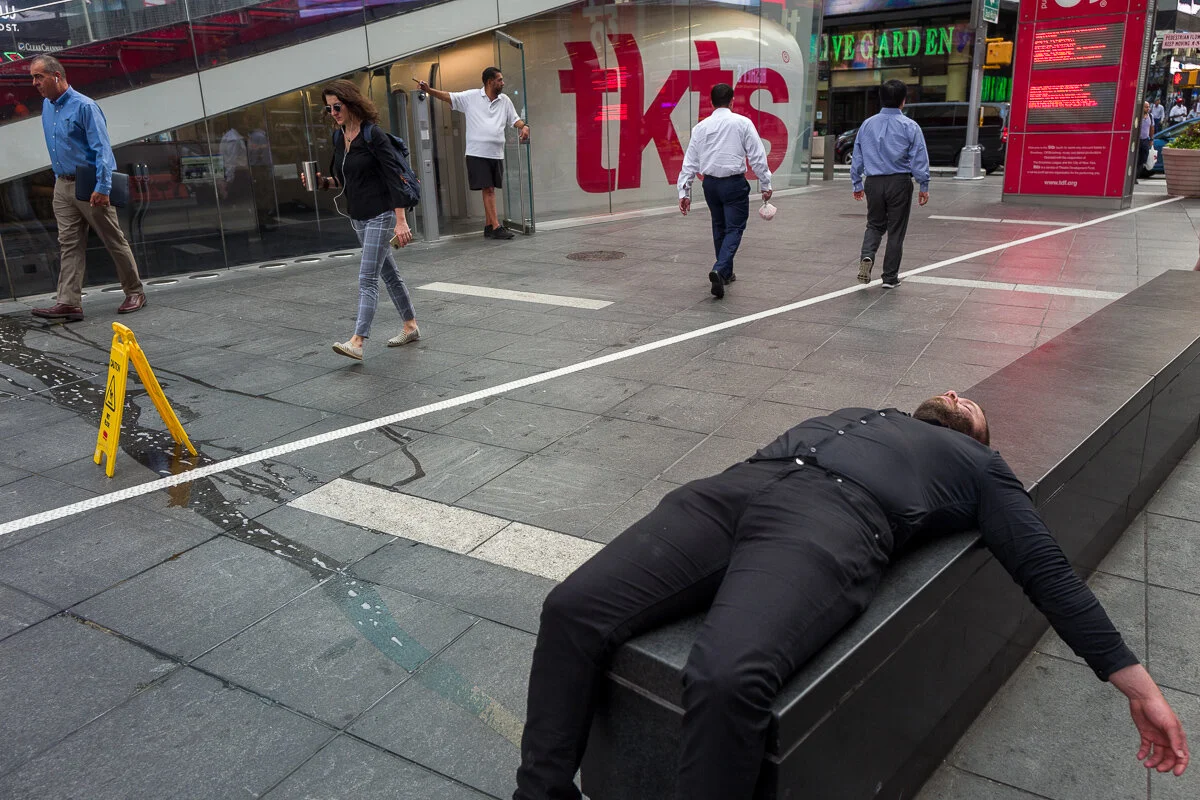
In Las Vegas, European luxury brands line a boulevard in the Nevada desert, every car on it completely ordinary. In Times Square, a man lies collapsed on a bench while the city moves around him without looking. In Santa Monica, a woman hides her face in the middle of all the spectacle.
None of these are anomalies. They are the street telling you something the official version of the place is not saying.

One Image, Los Angeles
There is one photograph from this series I keep coming back to.
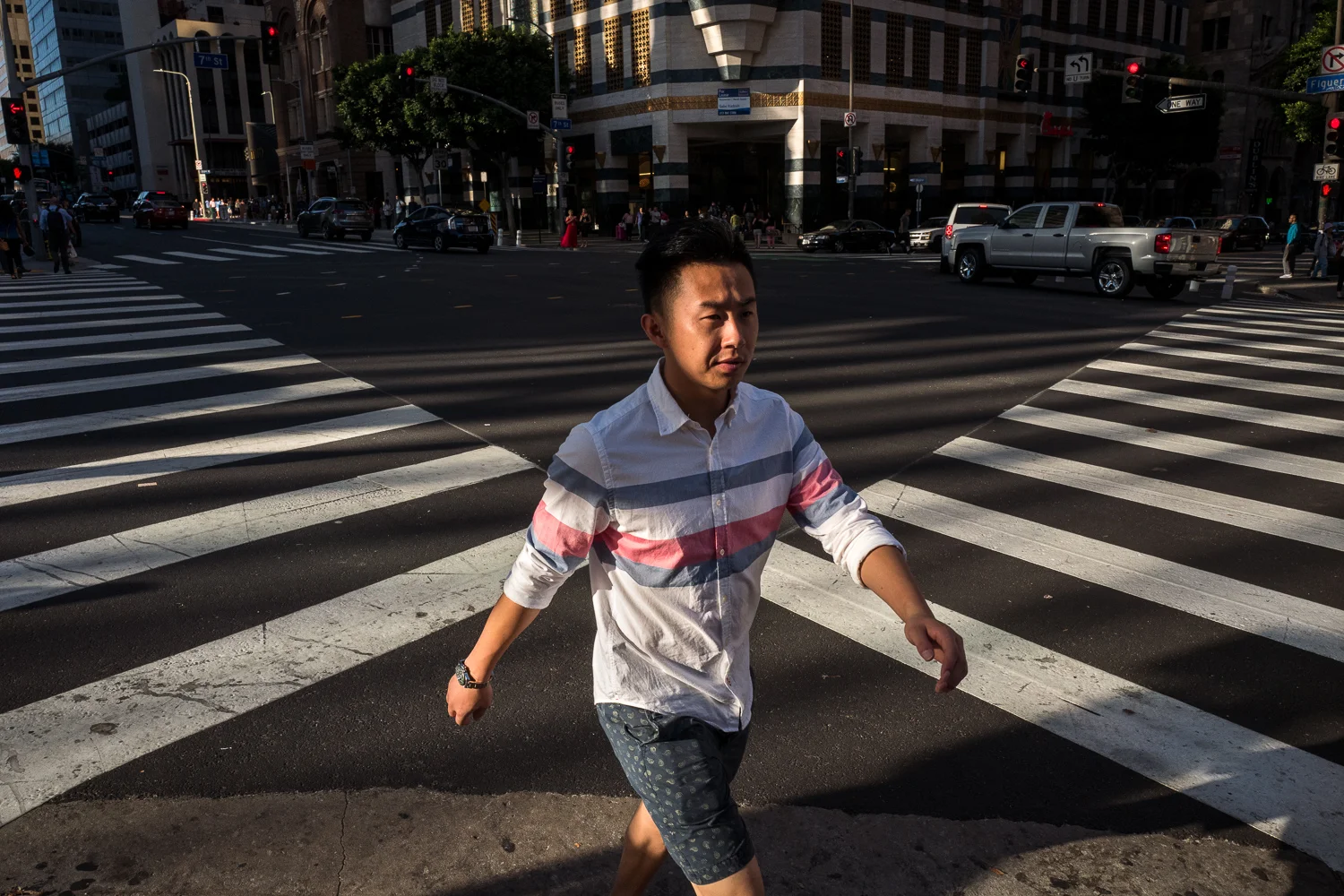
Downtown Los Angeles, late afternoon. A young man crosses an intersection, two pedestrian crossings meeting at a right angle, white stripes cutting across dark asphalt. He is walking fast, arms swinging, slightly off-balance, the way you do when you are moving through a city that does not slow down for anyone.
What stopped me was the synchronicity. The horizontal stripes on his shirt, blue, white, red, echo exactly the decorative bands running across the building behind him. He has no idea. But for a fraction of a second, the geometry aligned: the man, the crossings, the architecture, all of it folding into each other. He became part of the street rather than someone moving through it.
That is the kind of moment street photography exists for. Not the dramatic. Not the exceptional. The instant where a person and a place briefly become the same thing.
Shooting America as an Outsider
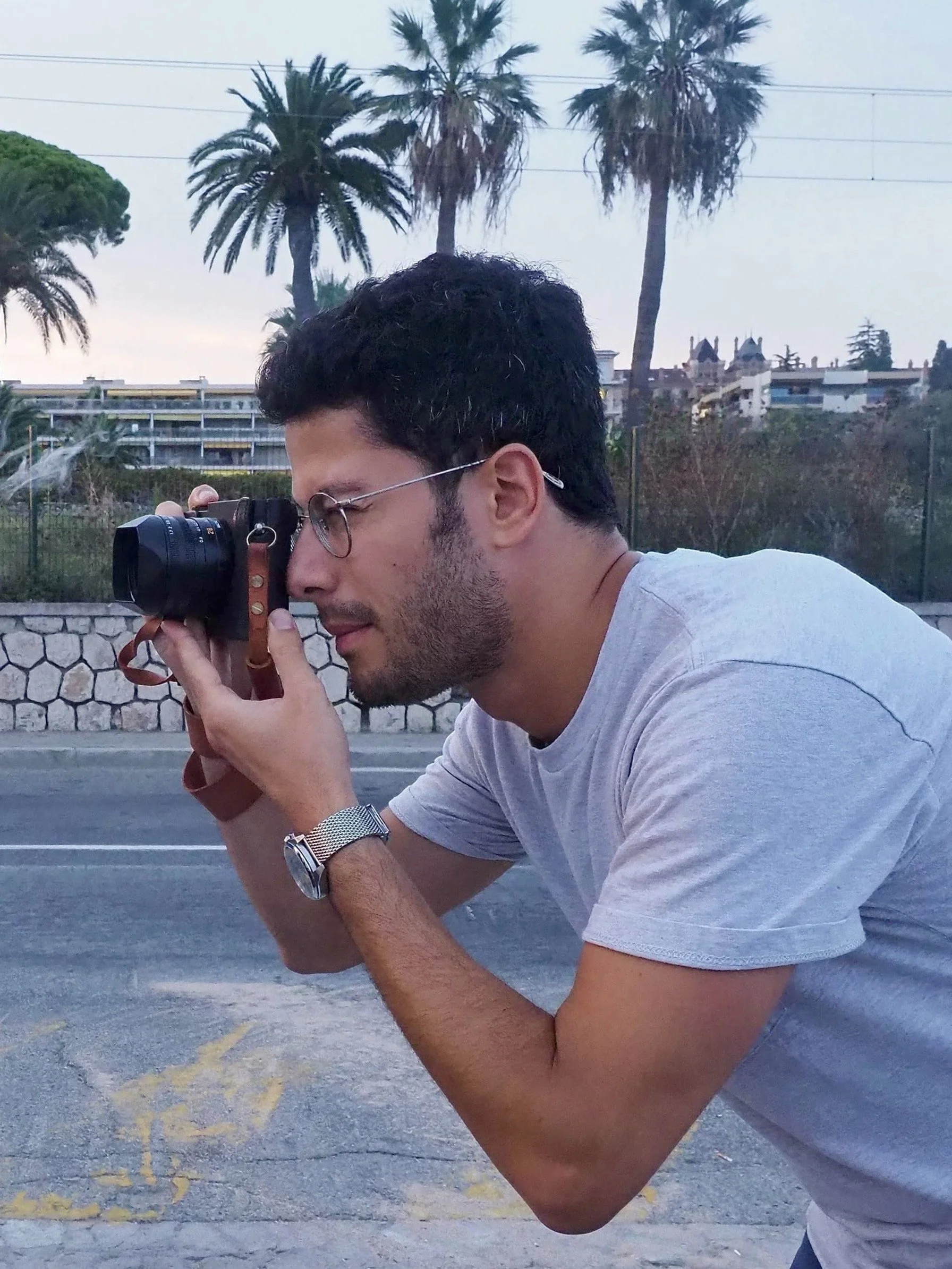
I work with a Leica. In Europe, in Nice, on the Côte d'Azur, the Leica is a tool for discretion, small, silent, close to the body. In America, the scale changes everything. The streets are wider. The distances between things are larger.
What did not change was the approach. Stay close. Stay patient. Let the street build its own geometry before you decide to photograph it.
Coming from Algeria, from France, from the Mediterranean, I was watching America with a particular kind of attention. Not the attention of someone who grew up inside the myth, but of someone who had spent decades absorbing it from the outside. That distance is an instrument. It lets you see the gap between the performance and what is actually happening on the sidewalk.
Los Angeles, San Diego, Las Vegas, New York
Each city in this series has its own logic.
Los Angeles is about scale and solitude. Enormous intersections, enormous skies, and people moving through it all as if the city were a set rather than a place to live. The light is cinematic because cinema invented itself here. You feel that even on the street.
Las Vegas is the most explicit version of the American performance. Everything is borrowed, everything is amplified, everything is a copy of something else dressed up as the original. Walking the Strip with a camera is almost too easy. The real photographs are off it, in the ordinary spaces between the spectacle.
San Diego is quieter but carries its own contradictions: the border, the military, the beach culture, the sense of a city unsure of its own identity.
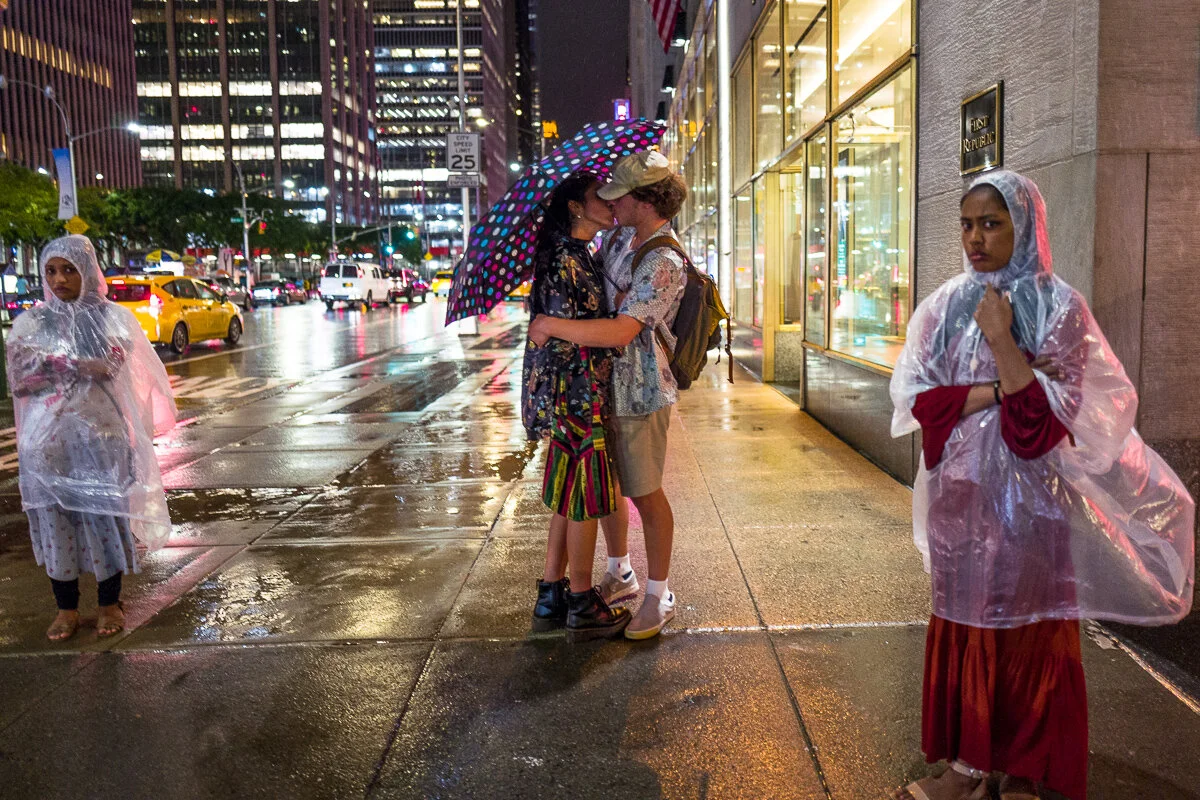
New York is the city that needs no myth because it has become the myth. But even there, on the sidewalks of Manhattan, the gap between the image and the reality is visible if you stand still long enough and look.
The Gear: Leica Q with its fabulous 28mm in America
I shot the entire series on the Leica Q, which meant working at 28mm. For street photography in Europe, I often work closer, tighter. The 28mm on the Leica Q pushed me even closer to people and to situations than my usual 35mm habits, which turned out to suit America perfectly.
American streets are built for distance. The blocks are long, the intersections are vast, the sidewalks are wide. A longer focal length would have let me stay comfortable, stay back, observe from afar. The 28mm did not allow that. To make the image I wanted, I had to be inside the scene, not watching it from the edge.
The Leica Q is also fast. The option to work manually when you want allows to be ready and pre-focus. In Las Vegas, where the light shifts constantly between blinding desert sun and neon shadow, having that responsiveness mattered. In New York, where everything moves at a pace that does not wait for photographers, it mattered even more.
In these cities, I felts that the camera was invisible. People saw a small black camera and looked away immediately. That invisibility was a gift.
Shooting in America vs. Shooting in Europe
Something I noticed: how free I felt photographing in America compared to shooting in Nice or elsewhere in Europe.
In France, in the Mediterranean, there is a particular social contract around being photographed in public. People notice much more. They sometimes object. The camera creates a negotiation, even a silent one, that you are always aware of.
In America, particularly in Los Angeles and New York, something different happens. The cities are so saturated with cameras, with filming, with content creation of every kind, that one more person pointing a lens at the street barely registers. People move through their day without breaking stride. They are used to being watched, used to being recorded. That indifference is not hostility. It is something closer to freedom, at least for the photographer.
It made me bolder. I moved closer than I usually would. I stayed in situations longer. The Leica Q at 28mm became almost an extension of my own field of vision rather than a device I was holding up between myself and the world.
The Series
The American Mirage is about scale, spectacle, solitude, and the distance between what America says about itself and what the street was actually saying to me.
It is also, in a way, about what it means to photograph a place you think you know before you arrive, and what happens when the real place starts to answer back.
Fine art prints from this series are available in limited editions. See the prints.